
Become a Crime Scene Investigator
CSI Jobs, Salary & Education Info
|
Get FREE Info From Schools |
Want to become a crime scene investigator? Discover jobs, education needed & the salary of a CSI, forensic scientist or technician.
Within the past decade, jobs as CSIs have been on a steady rise.
Whether this is because of the popularity of various crime shows on television, or the emerging scientific advancements in the field drawing new players, what we know for sure is this:
It is a good time to stud & pursue a career in criminal justice.
But what exactly does that mean? Being a CSI?
The truth is that there is no such position as a CSI.
This is more like a term that acts as a canopy over the many various jobs within an entire department or class of workers.
CSI Career Info
You can work for the police, the sheriff's office, or the FBI as a forensic scientist, biologist, analyst, crime scene technician, or supervisor and be considered a crime scene investigator.
If you're interested in a CSI career, there are many steps you need to take before you reach that final destination. Some of which include:
- Choosing your position
- Getting educated
- And getting hired
Criminology-Degree.com Editorial Staff's experience in this field is only one of immense joy. Pay is great, employment secure--we believe that getting a job in criminal justice is one of the best moves you can make.
In the following articles, we'll touch a bit on all of these subjects, helping you get on your way to a new, brighter future.
Crime Scene Investigator Education

Police Officer at Crime Scene |
Getting a CSI education to become a criminalist isn't a difficult endeavor at all.
If you have the drive, the motivation, and the resolve to do your best at all times, you can get your degree in no time at all.
Going back to school is frightening.
It's scary thinking about having no job, no money and starting from scratch in a field.
And unless you're going to school for your first time, you probably share these fears.
But, don't worry. It really isn't very difficult at all!
By going to a crime scene investigator school online, you can save time and money and not have to make such a jarring transition into a new life.
Keep your day job, take classes in your spare time, and in a few short years you can have your criminology, forensics, or criminal justice degree ready to go.
Here are a few great Internet-based institutions that can provide you with the degree you desire:
- Rasmussen College
- Everest College
- American InterContinental University
- University of Phoenix
- Argosy University
Become a Crime Scene Investigator
In order to become an official CSI, you must first get your education.
Here's what we suggest doing before getting an online criminology degree: Bookmark this site. Read up on as much as you possibly can. And figure out which CSI field is most appealing to you.
The more knowledge you have, the better prepared you will be to wow your potential new boss when it comes time to interview.
Salary of Crime Scene Investigator
The salary of a crime scene investigator is hard to pin down. As we mentioned, CSI covers a wide range of positions with a wide range of responsibilities and (you guessed it) a wide range of wages.
The different jobs under the CSI umbrella have salaries that range from $15 an hour doing data entry to over $200,000 a year for being a chief medical examiner.
Depending on your skill set, your vocation, and your ability to climb the rungs of the bureaucratic ladder, you could make anywhere from a good living to an outstanding one.
Here's a brief look at a few salary averages of CSIs to give you an idea of what you might expect:
- Crime Scene Technician Salary - From $20.40 to $22.00 an hour
- Forensic Autopsy Technician Salary - From $4,000 to $5,000 a month
- Deputy Medical Examiner Salary - From $50,000 to $200,000 a year
Crime Scene Investigator Jobs
There are so many jobs that fall under the umbrella of being a CSI that it's impossible to list them all.
If this is the field in which you want to devote your life's work, rest easy in knowing that there is a great variety of options before you.
The first thing you need to do is make a choice: in which areas do you want to work as a criminalist?
Would you rather work with DNA, blood, firearms, people, or environments? Are you better with math, biology, chemistry, physics, or simple detection? Do you want to work in an office, a lab, or in the field?

Computer Forensics Laboratory Work |
Once you begin to answer these questions, you'll be able to draw a finer bead on the specific CSI positions that work best with you.
Just to give you an idea of what there is to offer, here's a brief list of positions within the crime scene investigator world:
- Toxicologist
- Forensic Photographer
- Medical Examiner
- Autopsy Technician
- Latent Fingerprint Technician
- Biometrics Trainer
- Evidence Custodian
- DNA Analyst
- Forensic Scientist
- Serologist
- Trace Analyst
- Vehicle Reconstructionist
And the list just goes on and on. Whatever you have an aptitude for, there's a position that will take advantage of it.
And best of all, the pay's great and the job's secure! What more could you ask for?
Oh, yeah, and you can get your education online! This helps so many with a smooth and seamless career transition--and we know it will be for you, too!
Crime Scene Investigator Job Description
By reading a bunch of crime scene investigator job descriptions closely, you begin to see a number of similarities. Sure every job is different, with different duties and responsibilities, but the general requirements are pretty closely related.
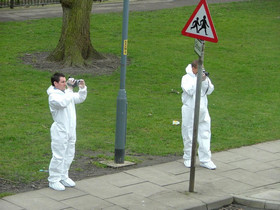
Car Accident Investigators at Scene |
Every job requires respect, discipline, honor, and perseverance.
Being a crime scene investigator isn't like any other job. You are working to solve a crime, to bring a fugitive to justice (or at least give reason to his or her actions), and potentially to save lives.
That might make it sound a bit more exciting or action-packed than the job truly is, but that's the reality.
As a CSI you are working to make a difference.
And no matter where your strengths lie, there are a number of positions that will fit your needs.
- Lab technician work
- Field investigation
- Office support
- Managing others
Each of these carries with it a long, long list of positions available. Take a look--you're sure to find one suited perfectly for you.
Top 10 Worst Lies Ever
The job of a criminal investigator involves seperating fact from fiction. Just for fun, we wrote up a quick post about the top 10 worst lies ever! Be sure to read it and share your thoughts
|
Get FREE Info From Schools |
Return from Crime Scene Investigator to Criminology Degree


